

ABOUT ALEXIS
A return
to self.
Alexis VeraCruz is a clinical hypnotherapist, former brain-mapping specialist, and biomedical engineer blending neuroscience and subconscious work to help individuals transform deeply rooted patterns, navigate life's transitions, and experience greater confidence, connection, and fulfillment.
I’ve always been curious about what makes us who we are.If you looked at my resume, becoming a hypnotherapist probably wouldn’t seem like the obvious next step.
I studied psychology and neuropsychology at William & Mary, went on to get my master’s in biomedical engineering, spent years working with qEEG brain mapping, and eventually moved into medical technology and surgical robotics. I’ve worked alongside psychologists, physicians, researchers, engineers, and some incredibly brilliant people trying to understand and change what happens inside the human body.
But when I look back, there is actually a really obvious thread through all of it.
I am endlessly curious about people.
I want to know why we become who we become. Why two people can live through similar experiences and walk away from them completely differently. Why we can consciously know something is true and still feel something entirely different. How our relationships, culture, families, emotions, and experiences become beliefs and expectations that quietly shape the way we move through the world.
And perhaps the question that has fascinated me most throughout my career is: how much of that can we actually change?
Long before hypnosis, I was looking at the brain.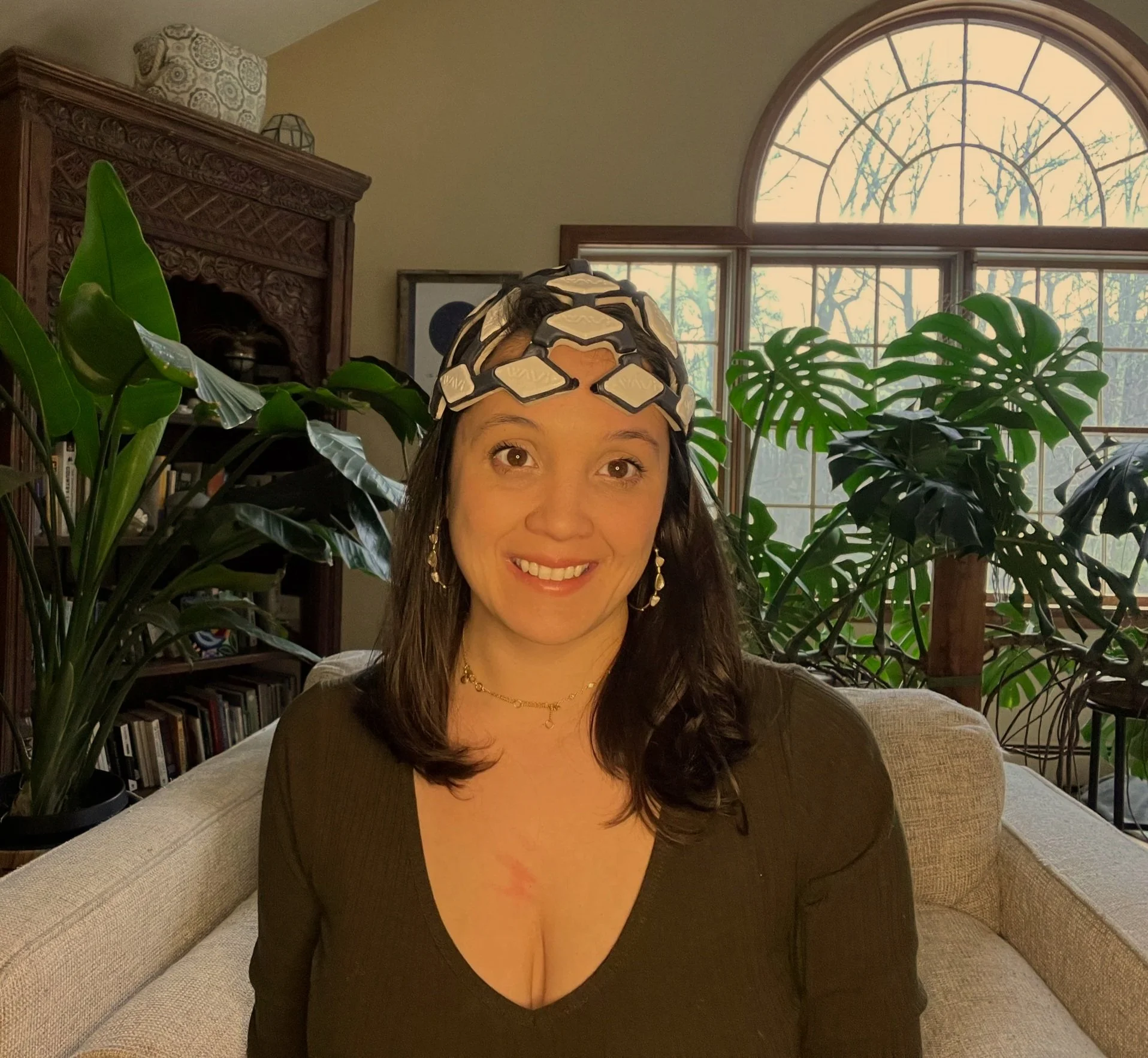
Early in my career I was working with qEEG brain mapping. I performed thousands of scans over the years, and had the opportunity to work on projects looking at the brain before and after different interventions.
I saw measurable changes in brain activity.
That was huge for me.
I had studied neuroplasticity academically, of course, but there is something different about actually watching the data change. It made the idea that our brains are continually responding to experience feel much less theoretical.
Our brains are constantly taking in information, making associations, predicting what comes next, and adapting based on what we've lived through. That ability is part of what makes us incredibly resilient, but it also means we can carry forward things we learned in completely different seasons of our lives without realizing we're doing it.
Something can make perfect sense for the version of you who learned it and make absolutely no sense for the woman you are now.
That became the part I couldn't stop thinking about.

My career took me deeper into science, but my questions kept getting more human.I went into biomedical engineering because I wanted to understand the body more deeply, and later worked in medical technology and surgical robotics. I loved being around science and innovation, and I still very much consider myself a science person.
But I've never believed that science and intuition need to be opposing philosophies.
The more I've learned about the brain, the more interesting human experience has become to me, not less.
We aren't just brains operating independently in little glass boxes. We are shaped by relationships, emotion, expectation, culture, memory, biology, environment, meaning, and thousands of experiences we don't consciously catalog.
And there are forms of intelligence that aren't easily captured on a spreadsheet.
I think this is particularly important for women, because so many of the things we have historically been taught to question about ourselves, our sensitivity, intuition, sensuality, empathy, emotional intelligence, receptivity, are actually incredibly valuable sources of information.
We don’t have to choose between information or intuition, we can lean into both.

Then I became a mother, and a lot of what I had spent years studying became personal.Motherhood cracked open questions about identity that I don't think I fully understood until I was living them. I adored my son, and I also found myself trying to figure out where I existed inside this completely consuming new role. I was reading the parenting books, listening to the podcasts, learning about attachment and child development, and trying incredibly hard to do things “right.”
And somewhere in all of that information, I started noticing how easy it was to lose confidence in my own knowing. There was always another expert with another opinion about how to feed your baby, get them to sleep, respond to a tantrum, regulate yourself, maintain your marriage, keep your career, heal your childhood, optimize your nervous system, and somehow enjoy all of it at the same time.
I love that we healing is a major topic of conversation today, and I also love all of the expertise, but I do think we've created a culture where it can become very easy to believe someone else must know more about how to live your life than you do.
That tension between learning from other people and still being able to hear yourself became incredibly important to me.
And then I lost my daughter, Vera more than halfway through my pregnancy. That experience changed my relationship with trust in a way that no amount of intellectual understanding could resolve. I could understand the biology of what happened. I could know logically that my body had not betrayed me. I could explain all of it.
And still, my body had lived through something devastating. That showed me, in a very personal way, the difference between knowing something and actually experiencing it as true.
And that is where hypnosis clicked for me.When I began studying hypnosis, it didn't feel like a departure from my scientific background. It felt like another piece of something I had already been studying for years.
Hypnosis is a natural state of focused attention that gives us a way to work more directly with subconscious beliefs, associations, expectations, and learned patterns. And what I found so compelling was that the subconscious wasn't nearly as mysterious or inaccessible as we tend to make it sound.
When I began studying hypnosis, it didn't feel like a departure from my scientific background. It felt like another piece of something I had already been studying for years.
Hypnosis is a natural state of focused attention that gives us a way to work more directly with subconscious beliefs, associations, expectations, and learned patterns.
And what I found so compelling was that the subconscious wasn't nearly as mysterious or inaccessible as we tend to make it sound.
We can actually work with it. We don't have to spend years endlessly analyzing every experience we've ever had or trying to consciously talk ourselves out of something our brains learned through experience. Hypnosis gives us a way to work with the pattern at another level and create a different experience for the brain to learn from.
For someone who had spent years looking at neuroplasticity and watching brains change, that made a tremendous amount of sense to me. It also gave me a way to bring together parts of myself and my career that I had previously thought belonged in completely different worlds.
The scientist and the intuitive. The engineer and the deeply emotional person. The woman who loves data and the woman who trusts what she feels. The mother, the partner, the ambitious part of me, the sensual part of me, the part that wants to understand everything and the part that has learned there are some things I will never be able to control.
NURA grew out of that integration.
What I believe nowI don't think most anyone needs another person telling them exactly how to live. We have plenty of that.
There is an endless supply of advice about how to parent, how to have a good marriage, how to heal, how to regulate your nervous system, how to manifest, how to eat, how to exercise, how to conceive, how to give birth, how to be feminine, how to be successful.
Some of it is wonderful. Some of it has changed my life. But if all of that information leaves you constantly wondering whether you're doing your own life correctly, I think we've missed the point.
I want the work we do together to make you trust yourself more, not need more advice.
That's a huge part of why I work in containers rather than imagining therapy as something you need to stay in indefinitely. We have a focused period of time to get curious about what is happening, understand the patterns underneath it, work with them through hypnosis, and give you tools you can continue using without me.
Because I am not particularly interested in making “healing” your next full-time job. I'm interested in what becomes possible when you're not spending so much energy second-guessing yourself.
How you parent when you're not trying to follow everyone else's instruction manual. How you communicate with your partner when you understand what is actually being activated underneath the argument. What intimacy feels like when you can be present in your body. What decisions you make when you can hear your own desires. What motherhood feels like when you don't believe becoming a mother required you to disappear.
That's the work I'm interested in because that's where your actual life is happening.

A little more about meI am a clinical hypnotherapist and neuroscience educator with a master's degree in biomedical engineering from the University of Denver and a bachelor's degree in psychology with a neuroscience emphasis from William & Mary.
Before NURA, my work spanned qEEG brain mapping, behavioral and psychological settings, medical technology, and surgical robotics. I've performed thousands of qEEG scans and have been involved in work examining measurable changes in brain activity before and after interventions. My additional training includes clinical hypnotherapy, NLP, and Brainspotting.
But credentials are only part of why I do this work the way I do.
I'm also a mother, a wife, someone who has experienced profound loss, someone who has rebuilt her relationship with her own body and intuition, and someone who is still incredibly curious about what it means to be a human being.
I don't have an interest in presenting myself as someone who has figured life out.
I have an interest in helping you get better at hearing yourself inside of yours.
That is NURA.
Question what you've absorbed. Find what's actually yours. Live from there.

The woman I love working withI'm drawn to working with people who are thoughtful, curious, and interested in understanding themselves. People who recognize that there's often more to our thoughts, emotions, and behaviors than what we consciously understand.
You may have read the books, been to therapy, or spent years exploring your own patterns. You might be able to explain exactly why you do what you do. And yet, there's something that understanding alone hasn't quite changed.
Perhaps there's a fear that keeps you from pursuing something you want. You struggle to access confidence when it matters most. You're navigating fertility, pregnancy, motherhood, or a significant life transition. Your relationships are bringing familiar patterns to the surface, or you're finding yourself responding in ways that no longer reflect who you want to be.
Sometimes, there's nothing particularly wrong. Life might look wonderful from the outside, but you know there's more intimacy, creativity, pleasure, connection, or aliveness you'd like to experience.
What interests me isn't simply helping you understand why these patterns exist. It's exploring what your mind has learned, how those experiences continue to influence your life, and what becomes possible when you begin experiencing yourself differently.
You don't have to spend the rest of your life responding to the world in ways you learned long ago.

THE NURA™ METHOD
Understanding the patterns shaping how you think, feel, relate, and move through life.
Most people do not struggle because they lack insight. In fact, many people I work with are deeply thoughtful, self-aware, and highly capable. They have read the books, done the therapy, listened to the podcasts, and understand exactly what they want to change.
And yet, they still find themselves caught in familiar emotional loops, relationship dynamics, self-protective behaviors, or nervous system patterns that seem to return no matter how much they know.
Because lasting change rarely happens through insight alone. Much of how we think, feel, respond, and move through life happens beneath conscious awareness.
Over time, experiences shape subconscious patterns and emotional associations. The brain and nervous system learn what feels safe, threatening, rewarding, acceptable, or necessary for connection and survival. These responses become familiar. And familiarity feels safe, it is your comfort zone.
Humans are wired toward what is known, even when what is comfortable is no longer aligned. That is part of why change can feel so difficult. We are often trying to move beyond patterns our nervous system once learned were necessary. You stop consciously choosing many of your responses and begin living from them.
A child who learned conflict felt unsafe may become highly agreeable. Someone who felt unseen may overperform for validation. A person who learned love felt inconsistent may struggle to trust or fully soften into connection.
These patterns are intelligent adaptations.
The challenge is that we continue carrying them long after the environment that created them is gone. And without awareness, we often recreate familiar dynamics, not because we want to suffer, but because the nervous system moves toward what feels known.
The NURA Method™ is designed to help you understand these deeper layers while creating meaningful change from the inside out.
Rather than focusing only on behavior or surface-level mindset shifts, we work with the subconscious patterns, emotional associations, nervous system states, and internal stories shaping how you experience yourself and the world around you.
At its core, the NURA™ method through four phases:
NOTICE
We begin by noticing what is happening beneath the surface. Emotional reactions, recurring patterns, body sensations, nervous system states, relationship dynamics, internal narratives, and moments of aliveness all carry information.
UNCOVER
Together, we begin exploring where these patterns may have formed, what emotional needs they were originally trying to meet, and the protective role they may still be playing.
REWIRE
Through hypnotherapy, emotional processing, nervous system awareness, somatic techniques, and intentional reinforcement, we begin creating new beliefs, emotional associations, and ways of relating.
ALIGN
As old patterns begin to loosen, greater congruence becomes possible. Relationships deepen. Expression becomes more honest. Decisions feel clearer. Life begins to feel more connected, grounded, and alive.
Your Questions, Answered
-
Hypnotherapy is a focused, relaxed state of attention that allows us to work more directly with subconscious patterns, emotional associations, beliefs, and nervous system responses that often sit beneath conscious awareness.
Many of the ways we react, cope, strive, relate, or feel stuck were learned through repeated experiences. Hypnotherapy helps us understand and shift those deeper patterns so change feels more natural and lasting.
Think of it less as mind control and more as working with the part of your mind that already drives much of how you think, feel, and move through life.
-
No. You are aware, present, and in control the entire time.
Most people describe hypnosis as feeling deeply relaxed, focused, or absorbed, similar to being immersed in a movie, driving on autopilot, meditation, or that space between waking and sleep.
You cannot be made to do anything against your values, and you are able to stop, speak, move, or open your eyes at any time.
-
Many people come to this work because they feel stuck in recurring emotional patterns, relationship dynamics, overwhelm, self-doubt, perfectionism, people-pleasing, burnout, anxiety, confidence struggles, or major life transitions.
Others come for conception, pregnancy, postpartum, motherhood, grief, emotional healing, identity shifts, or feeling disconnected from themselves.
At its core, this work is about understanding and shifting the deeper patterns shaping how you think, feel, relate, react, and move through life.
-
Because insight alone is rarely the whole story.
Much of how we think, react, relate, and move through life happens beneath conscious awareness. While the exact number is debated, much of the mind operates automatically through learned emotional patterns, beliefs, associations, and nervous system responses shaped through experience.
At some point, many of these patterns were adaptive. They helped us feel safe, connected, successful, protected, or in control.
The challenge is that we often continue running these same patterns on autopilot long after they no longer serve us.
Hypnotherapy helps us work more directly with those subconscious patterns, so we are not simply managing behavior or forcing change through willpower, but understanding what sits beneath it and creating enough safety to respond differently.
-
Sessions are collaborative and deeply personalized.
We begin by exploring what feels present, what pattern or goal you want to work with, and what may sit beneath it emotionally or subconsciously. From there, we move into a guided hypnosis process designed to help you access deeper emotional insight, release what no longer serves you, and begin reinforcing new beliefs, patterns, and ways of relating.
You are never “out of it.” Think deeply relaxed, aware, and engaged.
-
Every person is different, but meaningful change often happens through repetition and reinforcement.
Some clients experience powerful shifts quickly, while others benefit from deeper work over time. I typically recommend a multi-session process when we are working with long-standing emotional or subconscious patterns because change becomes more lasting when the nervous system has time to integrate and practice new ways of being.
-
Yes. Hypnosis has been studied across areas including stress, anxiety, pain, trauma, habit change, performance, emotional regulation, childbirth, and medical procedures.
Research suggests hypnosis supports changes in attention, perception, emotional processing, nervous system regulation, and behavior, which is one reason it has been explored for things like smoking cessation, pain reduction, confidence, easier labor experiences, performance enhancement, and behavior change.
There is also emerging research exploring hypnosis in fertility and IVF support, with studies showing improved outcomes in implantation rates.
Beyond the peer reviewed research, I have personally witnessed profound shifts in clients, including changes in confidence, emotional patterns, relationships, self-trust, stress responses, habits, and the way people move through major life transitions.
My work is informed not only by hypnotherapy, but by neuroscience, nervous system regulation, emotional processing, and my background in brain mapping (qEEG) and biomedical engineering.
-
Yes. I work with clients both virtually and in person in Columbus, Ohio. Hypnotherapy translates beautifully online, and many clients find they feel even more relaxed working from home.